
Signs of a Slab Leak and What to Do First
The clearest signs of a slab leak are a water bill that jumps with no change in habits, a warm patch on the floor, the sound of running water when every tap is off, and a musty smell or damp carpet with no obvious source. Because the leak sits under concrete, it often shows up as only one of those signs, not all of them at once.
Below is what a slab leak actually is, why it shows up more often in older West San Fernando Valley homes, and how a plumber confirms one without opening up your floor to go looking.
What is a slab leak, and why does it happen here?
A slab leak is a leak in a water line running under or inside a concrete foundation. Many Southern California homes are built slab on grade, meaning the supply lines were cast into or beneath the concrete when the house was poured. That is why All Plumbing Services treats a slab leak as a regional problem that comes up again and again, not a rare fluke.
Because the pipe is sealed inside concrete, the water it leaks has nowhere obvious to go. It often travels sideways under the slab before it ever reaches a spot you would notice. That is why the signs below matter more here than they would with an exposed pipe under a sink.
The signs of a slab leak you can notice yourself
A few things are worth checking before you call anyone. A water bill that climbs with no change in how your household uses water is the most common tell. A warm patch on the floor, especially one that was not warm before, points to a leak on the hot water line. The sound of running water when every faucet in the house is off is another. So is a musty smell, paint bubbling low on a wall, or a patch of yard that stays green through dry weather.
Any one of those on its own is worth a look. You do not need all of them at the same time, because the water is choosing one path out, not several.
Why older Valley homes see more slab leaks
The age of the pipe is the real driver. Census data puts 6,646 of Northridge's housing units in the 1950s building wave, which is a big part of how we work in Northridge. The median home in our Granada Hills service area dates to 1963. Homes from that era had galvanized steel water lines buried in or under the concrete slab, not the copper or plastic pipe used today.
Galvanized pipe is steel coated in zinc for corrosion resistance. That zinc coating wears away from the inside over decades of use. Once it is gone, the bare steel underneath starts to rust. Rust keeps eating at the pipe wall until it opens a pinhole or a larger break. The failure happens inside the pipe, where no one can see it coming. A 1950s or 1960s Valley house is not waiting to see if it gets a slab leak. It is waiting to see when.
Could the 1994 earthquake be behind it?
Sometimes, yes. The 1994 Northridge quake hit magnitude 6.7, just southwest of Northridge, and shook the ground harder than almost any quake ever recorded under a U.S. city. Galvanized steel pipe does not flex. Ground movement from that event, or smaller shaking since, can pull a joint apart under the slab, the same way it displaced drain lines elsewhere in the Valley.
That matters for diagnosis, not just history. A slab leak on a pre-1994 Northridge or Granada Hills home can sometimes trace back to that one time event instead of ordinary corrosion. Either way, the fix starts the same way: find the leak before opening anything.
How a plumber actually confirms a slab leak
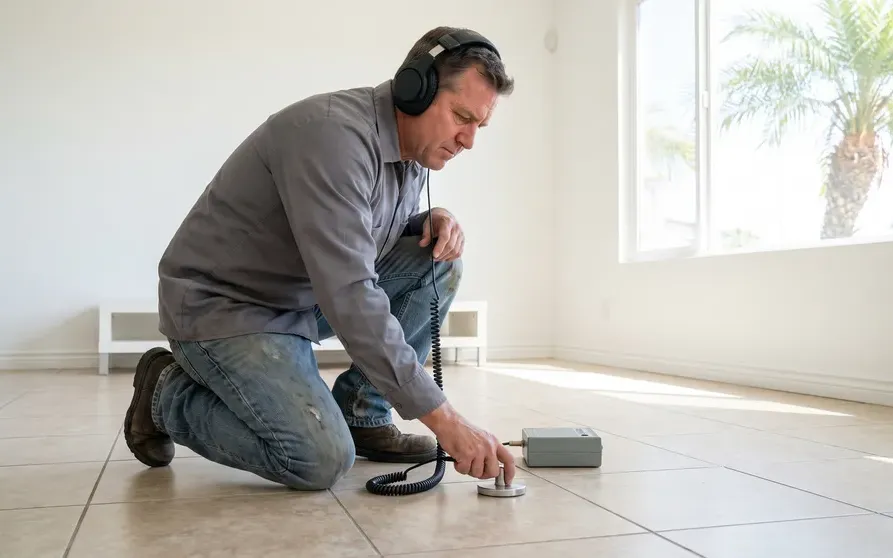
Our water leak detection and repair service locates a leak before opening anything, not after. The process starts by isolating the system and watching the meter. That step alone proves whether a leak is on the supply side at all. From there, sections of pipe get pressure tested to narrow down which run is losing water. Then comes electronic listening equipment. It picks up the sound of pressurized water escaping through concrete or drywall.
Only once there is a specific spot to point to does anything get opened up. Most locations take one to three hours. A slab leak under finished flooring takes longer. So does a house with more than one possible run, because each section has to be ruled out on its own. If your own hot water heater is the actual source, not the slab, water heater repair and replacement is the page that covers that instead.
What happens once the leak is found
Once the location is known, there is usually more than one honest way to fix it. A single failed section can often be cut out and repaired in place. Where the line under concrete is hard to reach, rerouting that one run above the slab can be less disruptive, and less expensive, than breaking concrete to get to it. Ask for a free estimate and we will explain both choices and what each one means for your floors before you decide.
As of 2026, HomeAdvisor and Angi report a national average cost of about $2,280 to repair a slab leak, including detection. Most homeowners pay between $630 and $4,400, depending on where the leak sits and whether the slab itself needs repair work. That is national market data, not a quote, and it is not how All Plumbing Services prices a job. The real number depends on the leak's location, how much testing it takes to find it, and whether the fix is a spot repair or a reroute. All of that gets explained up front, with a free estimate.
What to do right now
Find your main shut off valve today, before you need it. If water is actively running where it should not be, shut the main off and call All Plumbing Services. If what you have is a slow, hidden sign instead, a plumber can confirm it with a meter test and pressure isolation in a single visit, usually before anything gets opened up.
All Plumbing Services is a family owned plumbing contractor based in Chatsworth, CA, licensed, bonded and insured under CSLB #985835. The company opened in 2013. Owner David Karty has worked in plumbing for 35 years and still runs the jobs himself. An emergency means water actively running where it should not be. We answer those calls nights, weekends, and holidays. Every estimate is free before any work begins.
Talk to All Plumbing Services
Questions about your plumbing job? We serve Chatsworth and the surrounding area with honest, upfront advice.
Related articles
FAQ
Related questions
What causes a slab leak in an older Valley home?
Most often, a galvanized steel supply line that was cast under the slab decades ago. Galvanized pipe is steel coated in zinc, and that coating wears away from the inside over time. Once it is gone, the bare steel underneath rusts until it opens a pinhole. That failure happens inside the pipe where no one can see it, so there is no way to inspect it ahead of time. The pipe simply reaches the end of its life on its own schedule.
Does a slab leak always leave a wet spot I can see?
No, and that surprises a lot of homeowners. Water escaping under concrete has somewhere to go that is not your living room. A slab leak can show up only as a warm patch underfoot, a water bill that climbs with no change in habits, or a sound of running water when every tap in the house is off. One sign with no visible water is still a real leak, which is why a meter test is worth doing before waiting for a puddle that may never come.
Is a slab leak an emergency, or can it wait?
It depends on what you are seeing. If water is actively running where it should not be, shut off the main and call us, because that is an emergency regardless of the hour. A slow slab leak is different. It will not fix itself. The longer it runs, the more it adds to your water bill and the risk to your floors. But it usually does not need a same hour response the way an active flood does. Either way, it is worth a call soon rather than a wait and see approach.