Tankless vs. Tank Water Heater: Which Fits an Older Valley Home?
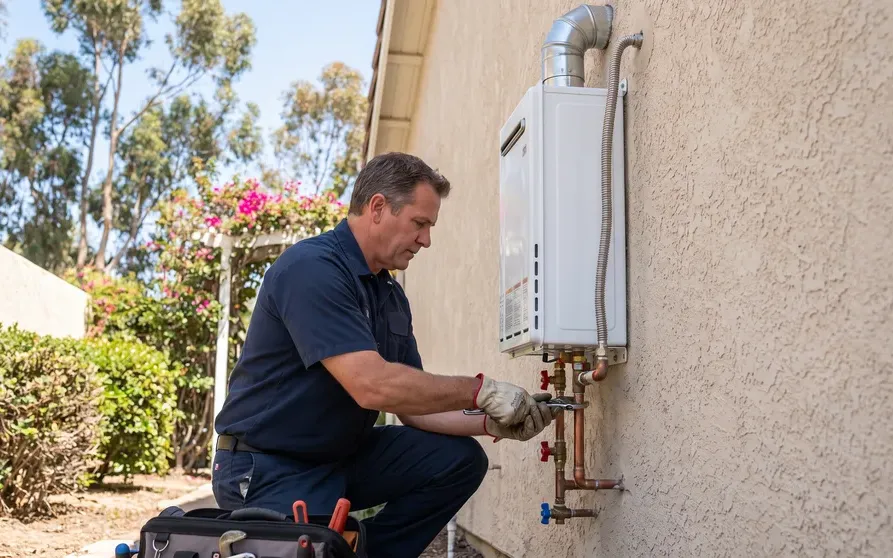
A tankless water heater usually wins for a household that runs hot water in long stretches and plans to stay; a tank wins for a quick, lower cost swap. In an older West San Fernando Valley home built in the 1950s or 60s, going tankless means upgrading the gas line and adding new venting, not a drop in replacement for the old tank.
Both choices are good water heaters. The right one depends on your house and how your family uses hot water. Here is how to think it through, plus the one thing most older Valley homes need before a tankless unit can go in.
Is a tankless water heater worth it?
A tankless water heater is worth it for a household that runs hot water back to back, like one shower right after another, and plans to stay in the home for years. It heats water as you use it instead of storing a tank of hot water, so it never runs out mid shower. It also gives you the floor space back, since there is no tank to tuck into a closet.
The tradeoff is the install itself. A tankless unit costs more up front to put in than a tank, mainly because of the gas line and venting work covered below. A tank is the cheaper, simpler swap when the household just wants hot water back and does not need the extra capacity.
If a quick, lower cost swap sounds like the better fit for your house, a straight tank replacement instead is a real option and All Plumbing Services will say so plainly rather than talk you into the more expensive job. Ask us for a straight answer on which one actually fits your household before you decide anything.
Why aren't older Valley homes built for tankless water heaters?
Older Valley homes were not built for tankless because they were plumbed and vented for a tank, not for a unit that heats water on demand. The median home in the Encino ZIP code 91436, part of this company's service area, was built in 1962, according to Census data. That is squarely inside the era when every house was designed around a tank sitting in a closet or alcove, fed by a gas line sized only for that tank.
This is not a rare situation. Three out of every four housing units in Encino predate 1980, including thousands built in the 1940s and 1950s, per the same Census data. That means the gas line and venting question below comes up across a large share of homes in this part of the Valley, not just on one unusual property. If your home is one of the many Encino homes built in the 1960s, this is almost always part of the conversation before a tankless quote is final.
Do I need to upgrade my gas line for a tankless water heater?
Often, yes. A tankless unit heats water the instant you turn on the tap, instead of slowly over time in a storage tank. That takes much more heat output than a tank style unit ever needed. Heat output is measured in BTU, the unit for how much heat a burner can put out. That usually means a bigger gas line than the one sized for the old tank.
A tankless unit also cannot share the tank's old flue or vent pipe. It needs its own dedicated venting, run correctly, because the exhaust it produces is different from what a tank puts out. Skipping the gas line upgrade or the new venting does not save the job. It leaves the unit struggling to keep up, shutting off and restarting when it should not (what plumbers call short cycling), or running unsafely.
All Plumbing Services checks the existing gas supply and vent path before the quote is final, and prices the gas line and venting work in up front. It is not a surprise charge added once the job has already started.
How long do tankless water heaters last compared to a tank?
A tankless unit can outlast a tank, but only with the right yearly care. All Plumbing Services fits isolation valves on every tankless install specifically so the unit can be flushed once a year without cutting into the pipe. That matters more here than in most of the country, because Southern California's hard water scales the unit's heat exchanger (the part inside that actually transfers heat into the water) every time it fires.
Skip the yearly flush and that scale builds up. A tankless unit that never gets flushed loses output years before it should, which erases a lot of the advantage that made it worth the bigger install cost in the first place. A tank style unit does not need this same yearly flush, but it also does not last as long on average and gives you a fixed amount of hot water at once rather than an unlimited supply.
Which one actually fits your household?
The honest answer depends on two things: how your household actually uses hot water, and how old your current tank really is. A tankless unit is sized by how many gallons per minute (GPM, the measure of how much hot water flows out at once) it can heat for your real peak demand, not by grabbing "the box on the shelf." The most common tankless complaint is an undersized unit, one that cannot keep up with two showers and a dishwasher running at once. That is why sizing gets matched to actual household use before any quote is final.
If your current water heater is a tank and it is working fine, you may not need to switch at all. The company has a simple rule for tanks, based on age and what failed. Under about eight years old with one bad part is usually a repair. Past ten to twelve years, or any leak from the tank body, means a replacement, since a rusted tank cannot be patched. A sound tank with one bad part does not need to become a tankless project to get fixed.
Either way you go, the unit's manufacturer covers the equipment itself, and All Plumbing Services' own workmanship warranty is separate and stated to you before work starts, running anywhere from one to twenty five years depending on the job. All Plumbing Services is licensed, bonded, and insured under CSLB #985835. Owner David Karty has 35 years in the plumbing trade and started the company in 2013.
A straightforward install through our tankless water heater installation service is often done in a single day on a home that already has enough gas supply and a good vent path. A full conversion from a tank, with a gas line upsize and new venting, commonly runs one to two days. Which one your house needs gets confirmed by looking at the actual gas supply and vent route, before you commit to anything.
Call All Plumbing Services to find out whether your home is ready for a tankless upgrade or whether a straight tank swap is the better move, and to see the rest of our plumbing services while you are at it.
Talk to All Plumbing Services
Questions about your plumbing job? We serve Chatsworth and the surrounding area with honest, upfront advice.
Related articles
FAQ
Related questions
Does a tankless water heater need yearly maintenance in Southern California?
Yes. All Plumbing Services fits isolation valves on every tankless install so the unit can be flushed once a year without cutting pipe. Southern California's hard water scales the heat exchanger every time it fires, and a unit that never gets flushed loses output years before it should.
Can I keep my tank and skip the tankless upgrade?
Yes, and for some households that is the right call. The company's own repair versus replace rule for tanks is based on age and failure mode: under about eight years with one failed part is usually a repair, and past ten to twelve years, or any leak from the tank body, is a replacement. A rusted tank cannot be patched, but a sound tank with one bad part does not need to go tankless to get fixed.
Does a tankless retrofit always mean a bigger gas line?
Often, yes, because a tankless unit draws far more heat (measured in BTU, the unit that describes how much heat a burner puts out) than a tank ever did, and it cannot share the old tank's flue or vent pipe. All Plumbing Services checks the existing gas supply and vent path first and prices any gas line or venting work into the quote up front, not as a surprise after the job starts.